How many times when watching somewhat at the Tv you said: "Please REPLAY that Scene...." You couldn't until you have had a machine called VideoRecorder........The TeleVideoRamaMuseum shows the Hi Tech behind Old Video Tape Recorders of all types VHS V2000 Beta VCR to show, one more time, what real technology engineering was instead of todays DRM gizmos Crap. Site under development, coming soon !
In Brief:
There are lots of vintage electrical and electronic items that have not survived well or even completely disappeared and forgotten.
Or are not being collected nowadays in proportion to their significance or prevalence in their heyday, this is bad and the main part of the death land. The heavy, ugly sarcophagus; models with few endearing qualities, devices that have some over-riding disadvantage to ownership such as heavy weight,toxicity or inflated value when dismantled, tend to be under-represented by all but the most comprehensive collections and museums. They get relegated to the bottom of the wants list, derided as 'more trouble than they are worth', or just forgotten entirely. As a result, I started to notice gaps in the current representation of the history of electronic and electrical technology to the interested member of the public.
Following this idea around a bit, convinced me that a collection of the peculiar alone could not hope to survive on its own merits, but a museum that gave equal display space to the popular and the unpopular, would bring things to the attention of the average person that he has previously passed by or been shielded from. It's a matter of culture. From this, the Tele Video Rama Web Museum concept developed and all my other things too. It's an open platform for all electrical Electronic TV technology to have its few, but NOT last, moments of fame in a working, hand-on environment. We'll never own Colossus or Faraday's first transformer, but I can show things that you can't see at the Science Museum, and let you play with things that the Smithsonian can't allow people to touch, because my remit is different.
There was a society once that was the polar opposite of our disposable, junk society. A whole nation was built on the idea of placing quality before quantity in all things. The goal was not “more and newer,” but “better and higher" .This attitude was reflected not only in the manufacturing of material goods, but also in the realms of art and architecture, as well as in the social fabric of everyday life. The goal was for each new cohort of children to stand on a higher level than the preceding cohort: they were to be healthier, stronger, more intelligent, and more vibrant in every way.
The society that prioritized human, social and material quality is a Winner. Truly, it is the high point of all Western civilization. Consequently, its defeat meant the defeat of civilization itself.
Today, the West is headed for the abyss. For the ultimate fate of our disposable society is for that society itself to be disposed of. And this will happen sooner, rather than later.
OLD, but ORIGINAL, Well made, Funny, Not remotely controlled............. and not Made in CHINA.
HOW TO USE THIS SITE:
- If you landed here via any Search Engine, you will get what you searched for and you can search more using the search this blog feature provided by Google. You can visit more posts scrolling the right blog archive of all posts of the month/year,
or you can click on the main photo-page to start from the main page. It starts from the most recent post to the older post simple clicking on the Older Post button on the bottom of each page after reading , post after post.
You can even visit all posts, time to time, reaching the bottom end of each page then click on the Older Post button.
- If you come here at the main page from a bookmark you can visit all the site scrolling the right blog archive of all posts of the month/year pointing were you want , or more simple You can even visit all blog posts, from newer to older, clicking at the end of each bottom page on the Older Post button.
So you can see all the blog/site content surfing all pages in it.
- The search this blog feature provided by Google is a real search engine. If you're pointing particular things it will search IT for you; or you can place a brand name in the search query at your choice and visit all results page by page. It's useful since the content of the site is very large.
Note that if you don't find what you searched for, try it after a period of time; the site is a never ending job !
Don't forget the past, the end of the world is upon us! Pretty soon it will all turn to dust!
Have big FUN ! !
©2010, 2011, 2012, 2013, 2014 Frank Sharp - You do not have permission to copy photos and words from this blog, and any content may be never used it for auctions or commercial purposes, however feel free to post anything you see here with a courtesy link back, btw a link to the original post here , is mandatory.
All sets and apparates appearing here are property of
Engineer Frank Sharp. NOTHING HERE IS FOR SALE !
--------------------------------------------------------------------------
Thursday, November 3, 2011
IRRADIO MOD:HV-51FP CHASSIS DECK INTERNAL VIEW.
Thursday, October 20, 2011
PHILIPS VR6462 YEAR 1986.
Philips is one of the largest electronics companies in the world. In 2009, its sales were €23.18 billion. The company employs 115,924 people in more than 60 countries.[1]
Philips is organized in a number of sectors: Philips Consumer Lifestyles (formerly Philips Consumer Electronics and Philips Domestic Appliances and Personal Care), Philips Lighting and Philips Healthcare (formerly Philips Medical Systems).
he
company was founded in 1891 by Gerard Philips, a maternal cousin of
Karl Marx, in Eindhoven, Netherlands. Its first products were light
bulbs and other electro-technical equipment. Its first factory survives
as a museum devoted to light sculpture.[2] In the 1920s, the company
started to manufacture other products, such as vacuum tubes (also known
worldwide as 'valves'), In 1927 they acquired the British electronic
valve manufacturers Mullard and in 1932 the German tube manufacturer
Valvo, both of which became subsidiaries. In 1939 they introduced their
electric razor, the Philishave (marketed in the USA using the Norelco
brand name).
Philips was also instrumental in the revival of the Stirling engine.
As a chip maker, Philips Semiconductors was among the Worldwide Top 20 Semiconductor Sales Leaders.
In December 2005 Philips announced its intention to make the Semiconductor Division into a separate legal entity. This process of "disentanglement" was completed on 1 October 2006.
On 2 August 2006, Philips completed an agreement to sell a controlling 80.1% stake in Philips Semiconductors to a consortium of private equity investors consisting of Kohlberg Kravis Roberts & Co. (KKR), Silver Lake Partners and AlpInvest Partners. The sale completed a process, which began December 2005, with its decision to create a separate legal entity for Semiconductors and to pursue all strategic options. Six weeks before, ahead of its online dialogue, through a letter to 8,000 of Philips managers, it was announced that they were speeding up the transformation of Semiconductors into a stand-alone entity with majority ownership by a third party. It was stated then that "this is much more than just a transaction: it is probably the most significant milestone on a long journey of change for Philips and the beginning of a new chapter for everyone – especially those involved with Semiconductors".
In its more than 115 year history, this co
unts
as a big step that is definitely changing the profile of the company.
Philips was one of few companies that successfully made the
transition from the electrical world of the 19th century into the
electronic age, starting its semiconductor activity in 1953 and
building it into a global top 10 player in its industry. As such,
Semiconductors was at the heart of many innovations in Philips over
the past 50 years.Agreeing to start a process that would ultimately lead to the decision to sell the Semiconductor Division therefore was one of the toughest decisions that the Board of Management ever had to make.
On 21 August 2006, Bain Capital and Apax Partners announced that they had signed definitive commitments to join the expanded consortium headed by KKR that is to acquire the controlling stake in the Semiconductors Division.
On 1 September 2006, it was announced in Berlin that the name of the new semiconductor company founded by Philips is NXP Semiconductors.
Coinciding with the sale of the Semiconductor Division, Philips also announced that they would drop the word 'Electronics' from the company name, thus becoming simply Koninklijke Philips N.V. (Royal Philips N.V.).
The
foundations of Philips were laid in 1891 when Anton and Gerard Philips
established Philips & Co. in Eindhoven, the Netherlands. The
company begun manufacturing carbon-filament lamps and by the turn of
the century, had become one of the largest producers in Europe.
Stimulated by the industrial revolution in Europe, Philips’ first
research laboratory started introducing its first innovations in the
x-ray and radio technology. Over the years, the list of inventions has
only been growing to include many breakthroughs that have continued to
enrich people’s everyday lives.In the early years of Philips & Co., the representation of the company name took many forms: one was an emblem formed by the initial letters of Philips & Co., and another was the word Philips printed on the glass of metal filament lamps.
One of the very first campaigns was launched in 1898 when Anton Philips used a range of postcards showing the Dutch national costumes as marketing tools. Each letter of the word Philips was printed in a row of light bulbs as at the top of every card. In the late 1920s, the Philips name began to take on the form that we recognize today.
The now familiar Philips waves and stars first appeared in 1926 on the packaging of miniwatt radio valves, as well as on the Philigraph, an early sound recording device. The waves symbolized radio waves, while the stars represented the ether of the evening sky through which the radio waves would travel.
In 1930 it was the first time that the four stars flanking the three waves were placed together in a circle. After that, the
stars and waves started appearing on radios and gramophones, featuring
this circle as part of their design. Gradually the use of the circle
emblem was then extended to advertising materials and other products.At this time Philips’ business activities were expanding rapidly and the company wanted to find a trademark that would uniquely represent Philips, but one that would also avoid legal problems with the owners of other well-known circular emblems. This wish resulted in the combination of the Philips circle and the wordmark within the shield emblem.
In 1938, the Philips shield made its first appearance. Although modified over the years, the basic design has remained constant ever since and, together with the wordmark, gives Philips the distinctive identity that is still embraced today.
Gerard Philips:
Gerard
Leonard Frederik Philips (October 9, 1858, in Zaltbommel – January 27,
1942, in The Hague, Netherlands) was a Dutch industrialist, co-founder
(with his father Frederik Philips) of the Philips Company as a family
business in 1891. Gerard and his younger brother Anton Philips changed
the business to a corporation by founding in 1912 the NV Philips'
Gloeilampenfabrieken. As the first CEO of the Philips corporation,
Gerard laid with Anton the base for the later Philips multinational.Early life and education
Gerard was the first son of Benjamin Frederik David Philips (1 December 1830 – 12 June 1900) and Maria Heyligers (1836 – 1921). His father was active in the tobacco business and a banker at Zaltbommel in the Netherlands; he was a first cousin of Karl Marx.
Career
Gerard Philips became interested in electronics and engineering. Frederik was the financier for Gerard's purchase of the old factory building in Eindhoven where he established the first factory in 1891. They operated the Philips Company as a family business for more than a decade.
Marriage and family
On March 19, 1896 Philips married Johanna van der Willigen (30 September 1862 – 1942). They had no children.
Gerard was an uncle of Frits Philips, whom he and his brother brought into the business. Later they brought in his brother's grandson, Franz Otten.
Gerard and his brother Anton supported education and social programs in Eindhoven, including the Philips Sport Vereniging (Philips Sports Association), which they founded. From it the professional football (soccer) department developed into the independent Philips Sport Vereniging N.V.
Anton Philips:
Anton
Frederik Philips (March 14, 1874, Zaltbommel, Gelderland – October 7,
1951, Eindhoven) co-founded Royal Philips Electronics N.V. in 1912 with
his older brother Gerard Philips in Eindhoven, the Netherlands. He
served as CEO of the company from 1922 to 1939.Early life and education
Anton was born to Maria Heyligers (1836 – 1921) and Benjamin Frederik David Philips (December 1, 1830 – June 12, 1900). His father was active in the tobacco business and a banker at Zaltbommel in the Netherlands. (He was a first cousin to Karl Marx.) Anton's brother Gerard was 16 years older.
Career
In May 1891 the father Frederik was the financier and, with his son Gerard Philips, co-founder of the Philips Company as a family business. In 1912 Anton joined the firm, which they named Royal Philips Electronics N.V.
During World War I, Anton Philips managed to increas
e
sales by taking advantage of a boycott of German goods in several
countries. He provided the markets with alternative products.Anton (and his brother Gerard) are remembered as being civic-minded. In Eindhoven they supported education and social programs and facilities, such as the soccer department of the Philips Sports Association as the best-known example.
Anton Philips brought his son Frits Philips and grandson Franz Otten into the company in their times. Anton took the young Franz Otten with him and other family members to escape the Netherlands just before the Nazi Occupation during World War II; they went to the United States. They returned after the war.
His son Frits Philips chose to stay and manage the company during the occupation; he survived several months at the concentration camp of Vught after his workers went on strike. He saved the lives of 382 Jews by claiming them as indispensable to his factory, and thus helped them evade Nazi roundups and deportation to concentration camps.
Philips died in Eindhoven in 1951.
Marriage and family
Philips married Anne Henriëtte Elisabeth Maria de Jongh (Amersfoort, May 30, 1878 – Eindhoven, March 7, 1970). They had the following children:
* Anna Elisabeth Cornelia Philips (June 19, 1899 – ?), married in 1925 to Pieter Franciscus Sylvester Otten (1895 – 1969), and had:
o Diek Otten
o Franz Otten (b. c. 1928 - d. 1967), manager in the Dutch electronics company Philips
* Frederik Jacques Philips (1905-2005)
* Henriëtte Anna Philips (Eindhoven, October 26, 1906 – ?), married firstly to A. Knappert (d. 1932), without issue; married secondly to G. Jonkheer Sandberg (d. September 5, 1935), without issue; and married thirdly in New York City, New York, on September 29, 1938 to Jonkheer Gerrit van Riemsdijk (Aerdenhout, January 10, 1911 – Eindhoven, November 8, 2005). They had the following children:
o ..., Jonkheerin Gerrit van Riemsdijk (b. Waalre, October 2, 1939), married at Waalre on February 17, 1968 to Johannes Jasper Tuijt (b. Atjeh, Koeta Radja, March 10, 1930), son of Jacobus Tuijt and wife Hedwig Jager, without issue
o ..., Jonkheerin Gerrit van Riemsdijk (b. Waalre, April 3, 1946), married firstly at Calvados, Falaise, on June 6, 1974 to Martinus Jan Petrus Vermooten (Utrecht, September 16, 1939 – Falaise, August 29, 1978), son of Martinus Vermooten and wife Anna Pieternella Hendrika Kwantes, without issue; married secondly in Paris on December 12, 1981 to Jean Yves Louis Bedos (Calvados, Rémy, January 9, 1947 – Calvados, Lisieux, October 5, 1982), son of Georges Charles Bedos and wife Henriette Louise Piel, without issue; and married thirdly at Manche, Sartilly, on September 21, 1985 to Arnaud Evain (b. Ardennes, Sedan, July 7, 1952), son of Jean Claude Evain and wife Flore Halleux, without issue
o ..., Jonkheerin Gerrit van Riemsdijk (b. Waalre, September 4, 1948), married at Waalre, October 28, 1972 to Elie Johan François van Dissel (b. Eindhoven, October 9, 1948), son of Willem Pieter
(To see the Internal Chassis Just click on Older Post Button on bottom page, that's simple !)
PHILIPS VR6462 CHASSIS DECK INTERNAL VIEW.
Saturday, September 10, 2011
SABA ULTRAVIDEO 8A10 PAL-SECAM E-VERSION YEAR 1986


The Schwarzwälder Apparate-Bau-Anstalt (SABA) was a German manufacturer for electronic equipment founded in 1923 at Triberg im Schwarzwald (Black Forest), present-day Baden-Württemberg.
The former clock maker began producing component parts for broadcast receivers until it acquired a manufacturing license for complete radio sets in 1927. SABA quickly expanded, moved to a larger factory building at Villingen in 1932 and over the years became a long-time rival of the leading Telefunken company. After World War II the firm entered into the production of tape recorders, television sets and even established a record label, the later MPS Records company.
When faced with increasing competitive pressure, the shareholders sold the majority of the company to the GTE Corporation in order to generate synergy effects with GTE's Sylvania brand. Nevertheless in 1980 the remaining tv set production was finally purchased by Thomson SA.
In 1879 Elihu Thomson and Edwin Houston formed the Thomson-Houston Electric Company in the United States.
On April 15, 1892 Thomson-Houston and the Edison General Electric Company merged to form General Electric (GE). Also in 1892 the company formed a French subsidiary, Thomson Houston International.
In 1893 Compagnie Française Thomson-Houston (CFTH) was set up as a partner to GE. It is from this company that the modern Thomson companies would evolve.
In 1966 CFTH merged with Hotchkiss-Brandt to form Thomson-Houston-Hotchkiss-Brandt (soon renamed Thomson-Brandt). In 1968 the electronics business of Thomson-Brandt merged with Compagnie Générale de Télégraphie Sans Fil (CSF) to form Thomson-CSF. Thomson Brandt maintained a significant shareholding in this company (approximately 40%).
In 1982 both Thomson-Brandt and Thomson-CSF were nationalized by François Mitterrand. Thomson-Brandt was renamed Thomson SA (Société Anonyme) and merged with Thomson-CSF.
From 1983 to 1987 a major reorganisation of Thomson-CSF was undertaken, with divestitures to refocus the group on its core activities (electronics and defence). Thomson-CSF Téléphone and the medical division were sold to Alcatel and GE respectively. The semiconductor businesses of Thomson CSF was merged with Finmeccanica. Thomson acquired General Electric’s RCA and GE consumer electronics business in 1987.
In 1988 Thomson Consumer Electronics was formed, renamed Thomson Multimedia in 1995. The French government split the consumer electronics and defence businesses prior to privatisation in 1999, those companies being Thomson Multimedia (today Technicolor SA) and Thomson-CSF (today Thales Group).
Thomson-CSF was a major electronics and defence contractor. In December 2000 it was renamed Thales Group.
Thomson-CSF independence
Following the privatisation of the Thomson Group Thomson-CSF explored the possibility of merging with Marconi Electronic Systems, however British Aerospace was successful in that aim, forming BAE Systems.In 2000 Thomson-CSF went through a series of transactions, including with Marconi plc. The major acquisition at this time was the £1.3 billion purchase of the British defence electronics firm, Racal. This made Thomson-CSF the second largest participant in the UK defence industry after BAE. Racal was renamed Thomson-CSF Racal plc.
On December 6, 2000 the group was renamed Thales.
------------------------------------------------------
Wednesday, August 3, 2011
HITACHI VT-110E YEAR 1986.


Hitachi, Ltd. ( Kabushiki-gaisha Hitachi Seisakusho) specializing in high-technology and services headquartered in Marunouchi 1-chome, is a Japanese multinational corporationChiyoda, Tokyo, Japan. The company is the parent of the Hitachi Group (Hitachi Gurūpu) as part of the larger DKB Group companies. Hitachi is the third largest technological company by revenue as of 2009.
| Corporate Name | Hitachi, Ltd. (Kabushiki Kaisha Hitachi Seisakusho) |
|---|---|
| Established | February 1, 1920 [Founded in 1910] |
| Headquarters | 6-6, Marunouchi 1-chome, Chiyoda-ku, Tokyo, 100-8280 Japan phone:+81-3-3258-1111 |
| Management | Hiroaki Nakanishi Representative Executive Officer and President |
| In-house Company System |
|
HISTORY PROGRESSION:
1910-1919 1910
* Company formed.Completed five-horsepower induction motor
1911
* Completed 2-kVA transformer
1914
* Started production of AC ammeter and voltmeter
1916
* Completed 10,000-hp (7,355-kW) water turbine
* Started production of fans
1920-1929 1924
* Completed the first large-scale DC electric locomotive to be manufactured in Japan *figure2
1930-1939 1930
* Started production of pole-top transformers
1931
* Completed 10,000-A hydraulic electrolytic cell
1932
* Started production of elevators
* Completed Hitachi's first electric refrigerator *figure3
1933
* Completed 23,600-housepower Illgner set
1940-1949 1940
* Completed 5,000-line automatic private branch exchange
1943
* Completed 85,000-kW Francis water turbine and 70,000-kVA alternating current generator
1949
* Completed first U05 power excavator
1950-1959 1951
* Completed 6,500-kW Kaplan water turbine and 7,000-kVA AC generator (first umbrella-type generator made in Japan)
1952
* Completed 21,000-kW two-stage pump-turbine
1953
* Completed true low-pressure 300-m3/h air separation machine
* Completed 55,000-kW hydrogen-cooled turbine
1954
* Completed the first large-scale cold strip mill to be produced in Japan
1955
* Completed 100,000-kW Francis water turbine and 93,000-kVA alternating current generator
1956
* Completed the first DF90 diesel-electric engine to be built in Japan
1958
* Completed six-transistor miniature portable radio
* Electron microscopes awarded the grand prix at the World Exposition in Brussels *figure4
1959
* Completed electronic computers based on transistors
* Hitachi America, Ltd. established60-1969 1960
* Developed cubic-type refrigerator
1961
* Developed fully automatic washing machine
* Completed experimental nuclear reactor
1962
* Developed exothermic self-hardening mold
1963
* Completed 265,000-kW impulse reheating cross-compound turbine
1964
* Completed the first cars for the Shinkansen (Bullet Train)
* Developed seat reservation system for Japanese National Railways
* Manufactured monorail running between Haneda Airport and Hamamatsu-cho, Tokyo
1965
* Completed HITAC 5020 system
* Completed 19-inch 90° polarized color cathode ray tube using rare earth fluorescent elements
1966
* Developed LTP processing technique for silicon transistors
1967
* Developed dry-type room air conditioner
1968
* Developed hybrid LSI
* Completed HIDIC 100 electronic computer for control applications
* Developed 300-m/min elevators for high-rise buildings
1969
* Completed on-line banking system
* Developed and mass-produced all-transistor color televisions
* Developed Lo-D 2-Way speaker system
1970-1979 1970
* Developed computer-aided traffic control system for the Shinkansen (Bullet Train) *figure5
1971
* Competed large (1 Gbyte) file storage unit
1973
* Developed new-type image pickup tube
1974
* Developed numerically controlled ruling engine for aplanatic concave diffraction grating
* Commercial operation began at Japan's first 470,000-kW nuclear power station *figure6
* Successful automation of semiconductor assembly (automation of wire bonding for LSIs and transistors)
1975
* Developed high-performance heat transfer surface (Thermoexcell)
* Developed Hitachi High Crown Control Mill
* Completed large M-series computer system *figure7
1976
* Succeeded in trial of world's first optical transmission system
1977
* Developed high-speed amino acid analysis machine (type 837)
* Completed construction of Fugen advanced thermal converter reactor
1978
* Completed world's first field emission electron microscope with record-high resolution
* Experimental color camera with solid-state miniature image device developed
1979
* Completed HITAC M-series 200H
1980-1989 1980
* Completed 300-MW AC/DC converter for electricity link between Hokkaido and Honshu
1982
* Hitachi Europe Ltd. established
* Succeeded in world's first micro-level observation of magnetic field by the use of electron beam holography
1983
* Developed air conditioner with scroll compressor
1984
* Completed first improved standard BWR to be made in Japan
* Started mass production of 256-kilobit DRAMs *figure8
1985
* Completed the "JT-60" large-scale Tokamak device for break-even plasma experiments
* Developed CAD/CAE system with ultra-high resolution color display *figure9
1986
* Compared HITAC M-68X series
1987
* Practical application of predictive fuzzy control
* Completed large display using color liquid crystal projection
1988
* Developed quadrapedal robot
* Hitachi Asia Pte. Ltd. established
1989
* Developed world's fastest superconductive computer
* Developed superconductive MR imaging equipment
* Established two R&D centers in the U.S. and two laboratories in Europe
1990-1999 1990
* Released very large-scale computer with the world's fastest processing speed at that time
* Developed high-resolution TFT color liquid crystal display
1991
* Developed inverter-controlled electric locomotive with the world's largest control capacity
* Developed highly sensitive image pickup tubes
1992
* Completed core network 500-kV substation system
* Developed core technology for atomic manipulation and observation of atomic arrangement using scanning tunneling microscope
1993
* Developed Shinkansen (Bullet Train) with new maximum service speed of 270 km/h
* First in world to successfully demonstrate operation of single-electron memory at room temperature
* Developed capillary array DNA sequencer
1994
* Hitachi (China) Ltd. established
* Developed the original 32-bit RISC processor SuperH family
* Developed clean ATM
* Successful prototype of 1-Gbit DRAM
1995
* Developed Super TFT LCD module featuring ultra-wide viewing angles *figure10
* Developed 10-Gbit/s fiber optic transmission equipment
* Developed MULTI 2 encryption algorithm
1997
* Developed core technology for 4.7-Gbyte DVD-RAM
* Developed magnetocardiography technology for scanning cardiac patients
* Developed small proton accelerator for cancer treatment
1998
* Developed 320-Gbit/s optical data transmission system
* Developed refrigerator/air conditioner with PAM control
1999
* Commercialized lithium secondary battery using manganese system
2000- 2000
* Developed 52.5-Gbits/in2 perpendicular magnetic recording method
* Developed holographic electron microscope with 49.8-picometer resolution
2001
* Developed mobile web-gateway system
* Developed application processor for mobile phones
2002
* Developed world's smallest 0.3-mm square contactless IC chip *figure11
* Developed compact DNA analysis system genetic for SNP typing
2003
* Developed and commercialized compact, highly accurate, high-speed finger vein authentication system
* Successful measurement of infant brain functions using optical topography
* Dr. Hideaki Koizumi, a Hitachi Fellow, presented a lecture at the 400th Anniversary of the Foundation of the Pontifical Academy of Sciences, Vatican City
2004
* Developed world's smallest sensor-net terminal with a battery life of over one year
* Developed high-temperature lead-free solder paste
2005
* Explosives Trace Detection System received U.S. TSA certification
* Exhibited "EMIEW" two-wheel mobile robot capable of direct dialogue at the 2005 World Exposition Aichi, Japan
* Established Hitachi (China) Research & Development Corporation
2006
* Confirmation of electro-luminescence phenomena on injection of electrical current in ultra-thin silicon film
* Basic experiment on the application of Optical Topography as a brain-machine interface
* Mass production of 2.5-inch HDD using perpendicular magnetic recording technology
2007
* Prototype of world's smallest noncontact RFID powder IC chip (dimensions 0.05mm × 0.05mm)
* Prototype of the 2-Mbit non-volatile SPRAM chip using magnetization reversal by spin injection
* Developed EMIEW 2, a small and lightweight interactive robot *figure13
2008
* Developed lithium-ion battery system technology for use in high-speed diesel hybrid trains
* Developed technology for small but highly efficient electric motors that do not use rare metals
HITACHI VT-110E CHASSIS DECK INTERNAL VIEW.
Thursday, July 28, 2011
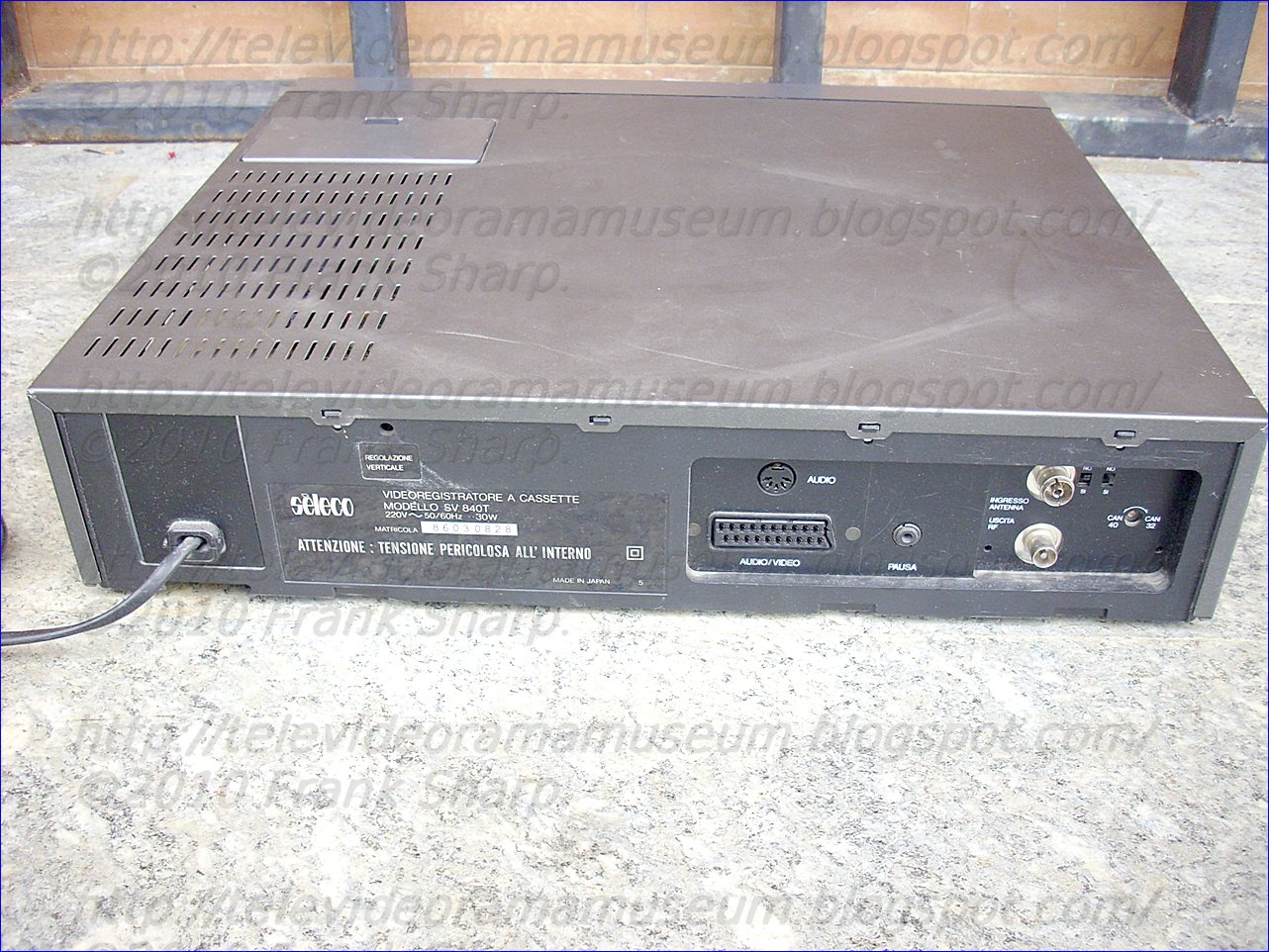
SELECO SV840T YEAR 1986.


REX Sèleco / Zanussi (WAS) is an electronics company based in Pordenone, Friuli Venezia Giulia, Italy. It is part of Super//Fluo, who bought the rights in August, 2006, along with Brionvega and Imperial.
Sèleco was born as in 1965 as a spin-off from the home appliances maker Zanussi. In the first years of his life, Seleco produced almost black and white televisions with the Zanussi or Rex brand. The company was being sold in 1984, and was first acquired by Gian Mario Rossignolo. He first became president and then main stockholder.
During the 1980s, the company launched worldwide marketing campaigns and began sponsoring some of the most famous Italian soccer team, such as Lazio A.S..
During the '90s, the company was mainly concentrated on the production of pay-tv decoders, but in 1993 suffered from a loss of competitivity. With the intent to reshape its position and to get gave new life to the company, Gian Mario Rossignolo bought Brionvega from the Brion family, the founder. This attempt get to nowhere, so the company was forced to declare failure in 1997. During the years, Sèleco has passed through ups and downs, at the end being overcome by the continuous changes in the electronics world.
After the crack-down, the company and all its interests were bought by the Formenti family. That gave life to the Seleco-Formenti Group, owner of the rights for the brands Sèleco, Rex, Phonola, Imperial, Stern, Phoenix, Televideon, Kerion and Webrik.
The Formenti family re-launched the company with the production of CRT-TVs. In 2000, the company suffered of a strong crisis, following the price dumping made by Turkish manufacturers. That seems to led to end of the Sèleco and Brionvega story, as the Sèleco-Formenti Group was forced to liquidation.
In 2004, the rights for the radio branch were bought by Sim2 Multimedia, and all the television interests (for the brands Sèleco, Brionvega and Imperial) were acquired by Super//Fluo in August 2006.
THIS INDUSTRY IS TODAY DEAD !!!!
Victor Company of Japan, Ltd (Nippon Bikutā Kabushiki-gaisha?) (TYO: 6792), usually referred to as JVC, is a Japanese international consumer and professional electronics corporation based in Yokohama, Japan which was founded in 1927. The company is best known for introducing Japan's first televisions, and developing the VHS video recorder.
1920s – 1960s
JVC was founded in 1927 as "The Victor Talking Machine Company of Japan, Limited" as a subsidiary of the United States' leading phonograph and record company, the Victor Talking Machine Company. In 1929 majority ownership was transferred to RCA-Victor. In the 1930s JVC produced phonographs and records, but in 1932 JVC started producing radios, and in 1939 they introduced Japan's first TV. JVC severed relations with its foreign partners during World War II, and was majority owned by Matsushita (Panasonic Corp.) from 1953 to Aug 2007. Finally it became JVC Kenwood Holdings in 2008 after Panasonic (Matsushita) decided to spin off the company and it was merged with Kenwood Electronics.
1970s – 1980s
In 1970, JVC marketed the Videosphere, a modern portable CRT television inside a space helmet shaped casing with an alarm clock at the base. It was a commercial success.
In 1971, JVC introduced the first discrete system for four channel quadraphonic sound sound on vinyl records - CD-4 (Compatible Discrete Four Channel) or Quadradisc, as it was called by RCA in the U.S. In 1976 JVC introduced the 3060, a 3" portable television with an included cassette player.
VC developed the VHS format, and introduced the first VHS recorders to the consumer market in 1977 for the equivalent of US $1060. Sony who had introduced the Betamax home videocassette tape a year earlier, became the main competitor to JVC's VHS into the 1980s creating the videotape format war. The Betamax cassette was smaller with slightly superior quality to the VHS cassette[citation needed], but this resulted in Betamax having less recording time. By 1984, forty companies utilized the VHS format in comparison with Betamax's twelve. Sony tacitly conceded defeat in 1988 when they also began producing VHS recorders.
In 1979, JVC demonstrated a prototype of their VHD/AHD disc system. This system was capacitance-based like CED, but the discs were grooveless with the stylus being guided by servo signals in the disc surface. The VHD discs were initially handled by the operator and played on a machine that looked like an audio LP turntable, but JVC used caddy housed discs when the system was marketed. Development was interrupted continually, but in April 1983 it was first marketed in Japan, and then in the UK in 1984 to a limited industrial market. By this time both Philips and Sony already had compact discs on the market, and the VHD format never caught on.
In 1981, JVC introduced a line of revolutionary direct drive cassette decks, topped by the DD-9, that provided previously unattainable levels of speed stability.
During the 1980s JVC had a brief appearance in marketing their own portable audio equipment similar to the Sony Walkmans at the time. The JVC CQ-F2K was released in 1982 and had a detachable radio that mounted to the headphones for compact, wire-free listening experience. JVC had difficulty making a success of the products, and a few years later abandoned the product line. In Japan, JVC marketed the products under the name Victor.
In 1986, JVC released the HC-95, a personal computer with a 3.58 MHz Zilog Z80A processor, 64KB RAM and ran MSX Basic 2.0. It included two 3.5" floppy disk drives and conformed to the graphics specification of the MSX-2 standard. However, like the Pioneer PX-7 it also carried a sophisticated hardware interface that handled video superimposition and various interactive video processing features. The JVC HC-95 was first sold in Japan, and then Europe, but sales were disappointing.
JVC video recorders were marketed by Ferguson in the UK, with just cosmetic changes. However Ferguson needed to find another supplier for its camcorders when JVC produced only the VHS-C format, rather than video8. Furthermore, Ferguson was taken over by Thomson SA and so ended the relationship. At the time, JVC had a reputation for reliable, high quality equipment. JVC has gone on to invent hard drive camcorders.
Present
In October 2001, the National Academy of Television Arts and Sciences presented JVC an Emmy Award for "outstanding achievement in technological advancement" for “Pioneering Development of Consumer Camcorders.” Annual sponsorships of the world-renowned JVC Tokyo Video Festival and the JVC Jazz Festival have helped attract the attention of more customers.
JVC has been a worldwide football supporter since 1982, having a former kit sponsorship with Arsenal and continued its role as an official partner of 2002 FIFA World Cup Korea / Japan. JVC made headlines as the first-ever corporate partner of the Kennedy Space Center Visitor Complex. JVC has recently forged elite corporate partnerships with ESPN Zone and with Foxploration. In 2005, JVC joined HANA, the High-Definition Audio-Video Network Alliance to help establish standards in consumer electronics interoperability.
JVC developed the first DVD+RW DL in 2005.
In December 2006, Matsushita entered talks with Kenwood and Cerberus Capital Management to sell its stake in JVC.
In 2007, Victor Company of Japan Ltd confirmed a strategic capital alliance with Kenwood and SPARKX Investment, resulting in Matsushita shareholding being reduced to approx 37%.[3]
In 2008, Matsushita (Panasonic) agreed to spin-off the company and merge with Kenwood Electronics, creating JVC Kenwood Holdings, formed on October 1, 2008.